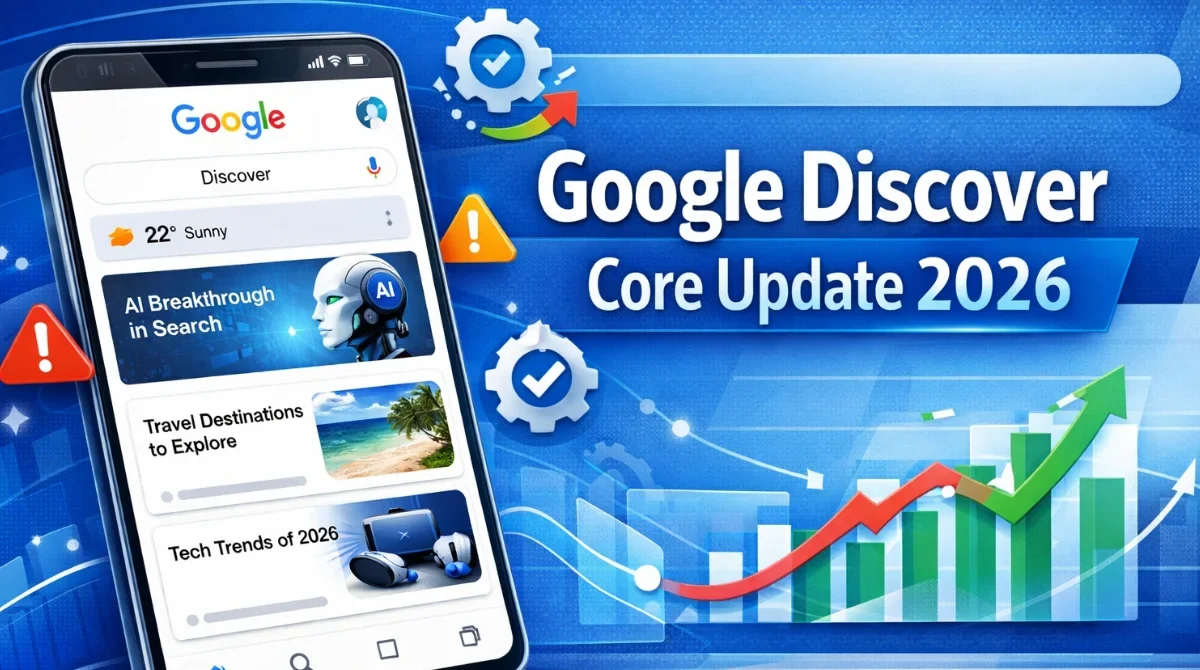
Google has introduced the February 2026 Discover Core Update, a major algorithm improvement focused specifically on the Google Discover feed rather than traditional web search rankings.
The rollout began on February 5, 2026, initially targeting English-language users in the United States, and was fully completed after roughly three weeks. Unlike traditional core updates that affect both search results and Discover, this update focuses entirely on how content is surfaced within Discover’s personalized content stream.
According to Google Search Central, the update aims to improve the quality of recommendations users see in Discover by prioritizing relevance, expertise, and originality.
Key Changes Introduced in the Update
Google’s latest Discover update focuses on improving the quality of content appearing in users’ feeds. The company highlighted several important changes that affect publishers and SEO professionals.
1: Stronger Focus on Local Content
One of the most notable adjustments is a stronger emphasis on locally relevant content. Discover will now prioritize articles and media from websites that are geographically aligned with the user’s country.
This means U.S.-based users are more likely to see content from U.S.-based publishers, while international publishers targeting U.S. audiences may experience temporary traffic shifts.
2: Reduction of Clickbait and Sensational Content
The update also aims to reduce sensational headlines and misleading clickbait.
Content designed primarily to attract clicks through exaggerated or misleading titles may lose visibility in Discover feeds. Instead, Google’s systems favor clear, accurate, and trustworthy headlines that reflect the actual content of the article.
3: Greater Emphasis on Expertise and Original Reporting
Another important change involves the prioritization of in-depth, original, and timely content created by websites that demonstrate expertise in a specific subject.
Google’s ranking systems analyze a site’s topical authority and consistency to determine whether it demonstrates expertise in a topic. Websites that regularly publish authoritative content in a particular niche are more likely to appear in Discover.
For example, a news website with a dedicated section covering gardening may develop recognized expertise in that subject, while a website that only occasionally publishes related articles may not receive the same visibility.
Impact on Publishers and SEO Professionals
Because the update is focused on Discover rather than search rankings, many websites may see changes in Discover traffic without corresponding changes in organic search rankings.
Publishers who rely heavily on Discover traffic should monitor performance through Google Search Console, where Discover data is reported separately from standard search traffic.
Sites that publish high-quality editorial content may benefit from improved visibility, while sites relying on click-driven headlines or shallow content could experience reduced Discover exposure.
Discover Optimization Best Practices
To adapt to the new Discover algorithm improvements, publishers should focus on several key practices:
- Publish Original and Insightful Content: Create content that provides unique perspectives, research, or analysis, rather than repeating widely available information.
- Build Topic Authority: Consistently publishing around specific subjects helps search systems understand your expertise and topical focus.
- Use High-Quality Visuals: Large, high-resolution images improve Discover eligibility and engagement.
- Avoid Misleading Headlines: Headlines should accurately summarize the article rather than exaggerating claims to drive clicks.
What Happens Next
While the update initially targets English-language users in the United States, Google plans to expand the algorithm changes globally in the coming months.
As the rollout continues internationally, publishers in other regions may begin to see similar adjustments in their Discover performance.
For SEO professionals and content publishers, the update reinforces a consistent message from Google: high-quality, original, and authoritative content remains the strongest signal for visibility across its platforms.