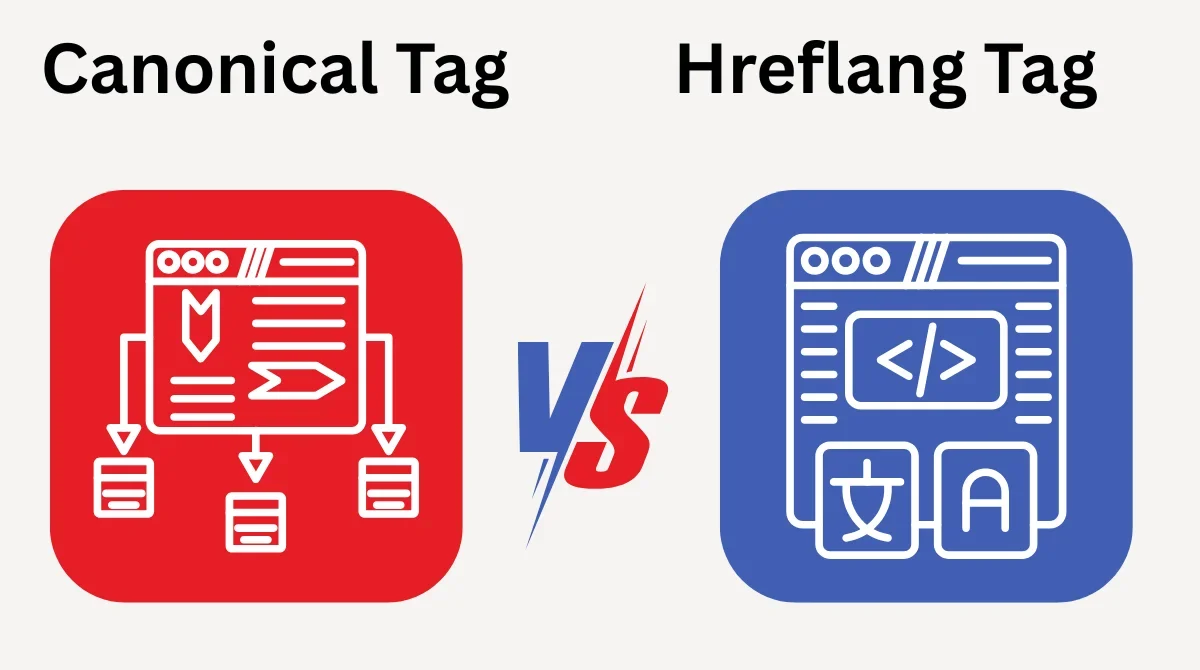
- What is an canonical tag in SEO?
- What is an hreflang tag in SEO?
- What is the difference between canonical and hreflang tags?
- How to Implement Hreflang and Canonical Tags Correctly?
- How Hreflang and Canonical Tags Influence SEO Performance?
- Maximizing SEO Performance with Hreflang and Canonical Tags
- Avoiding Common Pitfalls When Implementing Hreflang and Canonical Tags
- Final Thoughts
Search engines love clear, organized websites. But when your website has similar or duplicate pages, or when it targets users in multiple languages and countries, things can get confusing for both users and Google. That’s where canonical and hreflang tags come in.
These two technical SEO tags help you guide search engines on how to treat your pages, which version to index, which language to show, and how to avoid duplicate content issues.
What is an canonical tag in SEO?
When Google sees multiple identical or similar pages on a website, it has a hard time deciding which page to show in search results. To solve this problem, a special tag called the canonical tag is used. This tag indicates the original or official version of a page. This tag is usually used on duplicate or similar pages to clearly tell the search engine which is the original page.
The canonical tag (also known as rel=”canonical”) is actually a small piece of code that helps search engine crawlers understand which URL to index and rank as the original page. If you don’t use the canonical tag even though you have duplicate pages on your website, it can reduce your website’s page authority, cause ranking problems, and negatively impact SEO performance.
Examples for Canonical Tags
For example, you have an e-commerce website. It has a shoes product on it, and it has two colors, red and black.
- example.com/shoes?color=blue
- example.com/shoes?color=red
Search engines will consider these as duplicate pages and will have a hard time deciding which one to rank. In this case, you will implement the canonical tag on them.
<link rel=”canonical” href=”https://example.com/shoes” />
After implementing this tag, you can easily tell Google that its main page is https://example.com/shoes. This will eliminate all duplication, and Google will move to the main URL.
What is an hreflang tag in SEO?
The hreflang tag is also an HTML tag, like the canonical tag, but its purpose is different, which is to indicate the language and region for which the content of your website page is intended.
When a tag is placed on your website for the USA and another tag for the UK, when a user searches for your website in the USA, Google will show them the USA page and not the UK page. The advantage of implementing this tag is that you can easily rank your website in different languages.
You add this hreflang tag to the head section of your website, and big brands work on the same strategy, such as Nike and Adidas. In simple words, the summary of this is that by using this tag, you can rank your website in different countries, and it is mainly used in the international SEO strategy.
Examples of Hreflang Tags
A simple example of the hreflang tag is that, for example, you have a clothing brand and you want to rank it in India as well as in America, then you will simply apply this tag to it:
- For Indian users: <link rel=”alternate” hreflang=”en-in” href=”https://www.example.com/in/” />
- And for USA users: <link rel=”alternate” hreflang=”en-us” href=”https://www.example.com/us/” />
This way, when any user sitting in America searches our website, they will be shown href=”https://www.example.com/us/” by Google.
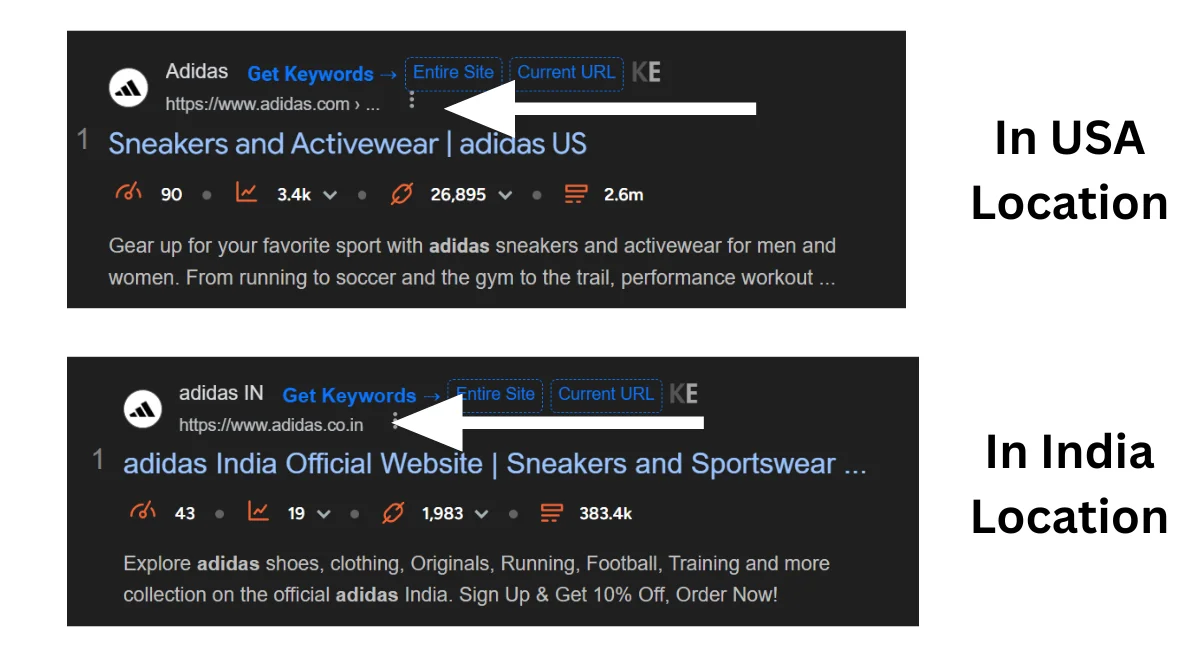
Let’s see a live example. I search for Adidas on Google, and by setting the USA location, Google will show us the USA page, and when I do it in India, it will show India. Just look at this example in the image below.
What is the difference between canonical and hreflang tags?
Both tags help Google understand your website better, but they serve very different purposes.
| Aspect | Hreflang Tag | Canonical Tag |
| Message | Which language and region is the specific page for? | Which page should be prioritized over the others? |
| Significance | The hreflang tag provides relevant content to the user based on their region and language. | Canonical prevents Google from indexing duplicate pages. |
| Authority | Each version of the page has its own authority. | Authority is centered on the canonical page. |
| Validation | Does in Google Search Console. | Does in Google Search Console. |
How to Implement Hreflang and Canonical Tags Correctly?
Procedure for Hreflang Tags
Follow these steps to add the Hreflang tag to your website:
- Language and region code: Use the correct code, based on the region and the language it is written in. For example, “en” for English and “fr” for French, and so on for other languages.
- Consistent implementation on pages: Make sure that each language version includes a reference to all other versions, including your own, to avoid having a single page. This helps search engines understand the scope of the offer.
- Sitemap inclusion: Include each hreflang tag attribute in the XML sitemap so that Google can easily crawl and index it.
- Implementation: For example, if your page is for Local SEO, you should implement the English tag in the USA.You simply: <link rel=”alternate” hreflang=”en-us” href=”https://www.example.com/local-seo/” /> Paste this tag in the <head> section of your website.
Canonical tag implementation process
Follow these steps to implement the canonical tag:
- Identify duplicate content: First, analyze which pages are similar and use the canonical tag on the main page to show Google which is the original page. Prevent the remaining duplicates from being indexed.
- Avoid multiple tags: Make sure that each page has only one canonical tag, not more than one, so that Google can better understand the main URL of your page.
- Internal link consistency: Make sure that your page’s internal links only point to the canonical version of your page. This method strengthens the health of your site.
- Implementation: You have to implement the canonical tag on the main page of the category of your same page, for example: https://www.example.com/shoes/ This: <link rel=”canonical” href=”https://www.example.com/shoes/” /> This tag has to be pasted in the <head> section of the website.
How Hreflang and Canonical Tags Influence SEO Performance?
Expanding Global Visibility with Hreflang Tags
In today’s interconnected digital landscape, delivering content tailored to regional languages and markets is essential. Hreflang tags allow search engines like Google and Bing to understand the intended audience for each version of a webpage. By specifying language and regional targeting for instance, en-US for English speakers in the United States or fr-FR for French users in France you ensure that users see the most relevant version of your content.
This localization strategy not only improves user experience but also reduces bounce rates and increases engagement metrics, which are critical signals for search engine ranking algorithms. According to industry studies, localized content can boost conversion rates by delivering more contextually appropriate experiences to users worldwide.
Mitigating Duplicate Content Challenges with Canonical Tags
Duplicate content can dilute your website’s authority, causing multiple URLs to compete for the same keywords. Canonical tags serve as a guide for search engines, indicating the “preferred” version of a page. For example, if your e-commerce site has multiple URLs for the same product, adding a canonical tag consolidates link equity and prevents ranking conflicts.
Proper canonical implementation ensures that SEO value is concentrated on your primary content, which helps maintain stronger organic search visibility and preserves the credibility of your website in the eyes of search engines.
Coordinating Hreflang and Canonical Tags for Maximum SEO Impact
Using hreflang and canonical tags in tandem creates a robust framework for both global and local SEO. While hreflang improves geotargeting and user relevance, canonical tags eliminate duplicate content issues. This synergy allows websites to rank efficiently across different regions without cannibalizing their own keywords.
For international websites, this approach ensures that search engines understand the hierarchy of pages, that each audience receives the correct content, and that crawl efficiency is optimized. In essence, coordinating these tags strengthens your website’s overall SEO architecture, driving better visibility, engagement, and conversion rates.
Key Takeaways:
- Hreflang tags → Serve localized content and improve global reach.
- Canonical tags → Consolidate SEO value and prevent duplicate content penalties.
- Combined strategy → Optimizes both local and international SEO performance.
Maximizing SEO Performance with Hreflang and Canonical Tags
- Enhanced Search Engine Comprehension: Implementing hreflang and canonical tags helps search engines accurately understand your website’s structure, language variations, and target markets. This ensures that crawlers index the correct pages, reducing confusion caused by duplicate or multilingual content, and improves your site’s visibility in search engine results pages (SERPs).
- Improved User Experience Across Regions: Hreflang tags allow your website to deliver content in the user’s preferred language and cultural context. When visitors see content tailored to their location or language, engagement rates increase, session duration grows, and bounce rates decrease strengthening your site’s overall SEO performance.
- Prevention of Duplicate Content Issues: Canonical tags are essential for consolidating multiple URLs that host similar or identical content. By signaling the preferred URL to search engines, canonical tags preserve link equity, maintain domain authority, and prevent dilution of ranking signals, which can otherwise harm your search visibility.
- Strategic Geographic Targeting: Leveraging hreflang tags allows precise targeting of specific countries, regions, and language audiences. This level of localization not only expands global reach but also drives higher conversion rates by connecting with visitors in a way that resonates with their cultural and regional expectations.
- Consolidation of SEO Value: Canonical tags ensure that all ranking signals including inbound links, social shares, and user engagement metrics are directed to a single authoritative URL. This strengthens your website’s domain authority, improves page rankings, and supports long-term organic growth in competitive markets.
By integrating hreflang and canonical tags into your SEO strategy, your website can efficiently deliver the right content to the right audience, safeguard against duplicate content penalties, and optimize performance across global search engines, ensuring sustainable growth and higher visibility.
Avoiding Common Pitfalls When Implementing Hreflang and Canonical Tags
Correct implementation of hreflang and canonical tags is essential for effective international SEO and proper search engine indexing. These tags help search engines understand which language or regional version of a page should appear in search results. However, incorrect configuration can cause duplicate content issues, wrong page targeting, and reduced organic visibility.
- Incorrect Hreflang URLs: Each hreflang tag must point to the correct language or regional version of the page. Every page should also include a self-referencing hreflang tag so search engines clearly understand that it belongs to the hreflang cluster.
- Incomplete Hreflang Sets: All language variations of a page must reference one another. If any version is missing from the hreflang set, search engines may not recognize the relationship between pages, which can reduce visibility in specific countries or languages.
- Missing Reciprocal Links: Hreflang tags must work bidirectionally. If an English page links to a Spanish version using hreflang, the Spanish page must also link back to the English page. Without these reciprocal links, search engines may ignore the hreflang signals.
- Multiple Canonical Tags: A page should only contain one canonical tag. Multiple canonical tags send conflicting signals to search engines and can result in incorrect indexing of your content.
- Canonical and Hreflang Conflicts: Avoid pointing the canonical tag to a different page while using hreflang for another. Each language page should have its own self-referencing canonical URL to maintain consistency.
- Redirects in Hreflang URLs: URLs used in hreflang tags should link directly to the final page. If the URL redirects, search engines like Google may ignore the hreflang annotation.
- Not Updating Tags After Site Changes: Whenever you change URLs, add new languages, or restructure your site, update the hreflang and canonical tags immediately. Regular monitoring through Google Search Console can help detect configuration errors and maintain a strong multilingual SEO structure.
Final Thoughts
Understanding the proper use of Canonical Tag and Hreflang Tag is essential for a strong international SEO strategy. Canonical tags help search engines identify the preferred version of a page and prevent Duplicate Content, while hreflang tags guide search engines to deliver the correct language or regional version of content to users.
When implemented correctly, these tags improve indexing, strengthen Technical SEO, and enhance the overall user experience. Regularly monitoring them through tools like Google Search Console ensures your multilingual website remains optimized and visible in global search results.